 Add to Chrome
 Add to Firefox
 Add to Edge
Articraft: An Agentic System for Scalable Articulated 3D Asset Generation
May 14, 2026
A bottleneck in learning to understand articulated 3D objects is the lack of large and diverse datasets. In this paper, we propose to leverage large language models (LLMs) to close this gap and generate articulated assets at scale. We reduce the problem of generating an articulated 3D asset to that of writing a program that builds it. We then introduce a new agentic system, Articraft, that writes such programs automatically. We design a programmatic interface and harness to help the LLM do so effectively. The LLM writes code against a domain-specific SDK for defining parts, composing geometry, specifying joints, and writing tests to validate the resulting assets. The harness exposes a restricted workspace and interface to the LLM, validates the resulting assets, and returns structured feedback. In this way, the LLM is not distracted by details such as authoring a URDF file or managing a complex software environment. We show that this produces higher-quality assets than both state-of-the-art articulated-asset generators and general-purpose coding agents. Using Articraft, we build Articraft-10K, a curated dataset of over 10K articulated assets spanning 245 categories, and show its utility both for training models of articulated assets and in downstream applications such as robotics simulation and virtual reality.

VGGT-$Ω$
May 14, 2026Recent feed-forward reconstruction models, such as VGGT, have proven competitive with traditional optimization-based reconstructors while also providing geometry-aware features useful for other tasks. Here, we show that the quality of these models scales predictably with model and data size. We do so by introducing VGGT-$Ω$, which substantially improves reconstruction accuracy, efficiency, and capabilities for both static and dynamic scenes. To enable training this model at an unprecedented scale, we introduce architectural changes that improve training efficiency, a high-quality data annotation pipeline that supports dynamic scenes, and a self-supervised learning protocol. We simplify VGGT's architecture by using a single dense prediction head with multi-task supervision and removing the expensive high-resolution convolutional layers. We also use registers to aggregate scene information into a compact representation and introduce register attention, which restricts inter-frame information exchange to these registers, in part replacing global attention. In this way, during training, VGGT-$Ω$ uses only about 30% of the GPU memory of its predecessor, allowing us to train with 15x more supervised data than prior work and to leverage vast amounts of unlabeled video data. VGGT-$Ω$ achieves strong results for reconstruction of static and dynamic scenes across multiple benchmarks, for example, improving over the previous best camera estimation accuracy on Sintel by 77%. We also show that the learned registers can improve vision-language-action models and support alignment with language, suggesting that reconstruction can be a powerful and scalable proxy task for spatial understanding. Project Page: http://vggt-omega.github.io/
Probing into Camera Control of Video Models
May 14, 2026Video is a rich and scalable source of 3D/4D visual observations, and camera control is a key capability for video generation models to produce geometrically meaningful content. Existing approaches typically learn a mapping from camera motion to video using additional camera modules and paired data. However, such datasets are often limited in scale, diversity, and scene dynamics, which can bias the model toward a narrow output distribution and compromise the strong prior learned by the base model. These limitations motivate a different perspective on camera control. In this paper, we show that camera control need not be modeled as an implicit mapping problem, but can instead be treated as a form of geometric guidance that induces displacements across frames. Specifically, we reformulate camera control into a set of displacement fields and apply them via differentiable resampling of latent features during denoising. Our simple approach achieves effective camera control with minimal degradation across diverse quality metrics compared to fine-tuned baselines. Since our method is applicable to most video diffusion models without training, it can also serve as a probe to study the camera control capabilities of base models. Using this probe, we identify universal biases shared by representative video models, as well as disparities in their responses to camera control. Finally, we benchmark their performance in multi-view generation, offering insights into their potential for 3D/4D tasks.
Syn4D: A Multiview Synthetic 4D Dataset
May 06, 2026Dense 3D reconstruction and tracking of dynamic scenes from monocular video remains an important open challenge in computer vision. Progress in this area has been constrained by the scarcity of high-quality datasets with dense, complete, and accurate geometric annotations. To address this limitation, we introduce Syn4D, a multiview synthetic dataset of dynamic scenes that includes ground-truth camera motion, depth maps, dense tracking, and parametric human pose annotations. A key feature of Syn4D is the ability to unproject any pixel into 3D to any time and to any camera. We conduct extensive evaluations across multiple downstream tasks to demonstrate the utility and effectiveness of the proposed dataset, including 4D scene reconstruction, 3D point tracking, geometry-aware camera retargeting, and human pose estimation. The experimental results highlight Syn4D's potential to facilitate research in dynamic scene understanding and spatiotemporal modeling.
SceneScribe-1M: A Large-Scale Video Dataset with Comprehensive Geometric and Semantic Annotations
Apr 09, 2026The convergence of 3D geometric perception and video synthesis has created an unprecedented demand for large-scale video data that is rich in both semantic and spatio-temporal information. While existing datasets have advanced either 3D understanding or video generation, a significant gap remains in providing a unified resource that supports both domains at scale. To bridge this chasm, we introduce SceneScribe-1M, a new large-scale, multi-modal video dataset. It comprises one million in-the-wild videos, each meticulously annotated with detailed textual descriptions, precise camera parameters, dense depth maps, and consistent 3D point tracks. We demonstrate the versatility and value of SceneScribe-1M by establishing benchmarks across a wide array of downstream tasks, including monocular depth estimation, scene reconstruction, and dynamic point tracking, as well as generative tasks such as text-to-video synthesis, with or without camera control. By open-sourcing SceneScribe-1M, we aim to provide a comprehensive benchmark and a catalyst for research, fostering the development of models that can both perceive the dynamic 3D world and generate controllable, realistic video content.
Stepper: Stepwise Immersive Scene Generation with Multiview Panoramas
Mar 30, 2026The synthesis of immersive 3D scenes from text is rapidly maturing, driven by novel video generative models and feed-forward 3D reconstruction, with vast potential in AR/VR and world modeling. While panoramic images have proven effective for scene initialization, existing approaches suffer from a trade-off between visual fidelity and explorability: autoregressive expansion suffers from context drift, while panoramic video generation is limited to low resolution. We present Stepper, a unified framework for text-driven immersive 3D scene synthesis that circumvents these limitations via stepwise panoramic scene expansion. Stepper leverages a novel multi-view 360° diffusion model that enables consistent, high-resolution expansion, coupled with a geometry reconstruction pipeline that enforces geometric coherence. Trained on a new large-scale, multi-view panorama dataset, Stepper achieves state-of-the-art fidelity and structural consistency, outperforming prior approaches, thereby setting a new standard for immersive scene generation.
PoseDreamer: Scalable and Photorealistic Human Data Generation Pipeline with Diffusion Models
Mar 30, 2026Acquiring labeled datasets for 3D human mesh estimation is challenging due to depth ambiguities and the inherent difficulty of annotating 3D geometry from monocular images. Existing datasets are either real, with manually annotated 3D geometry and limited scale, or synthetic, rendered from 3D engines that provide precise labels but suffer from limited photorealism, low diversity, and high production costs. In this work, we explore a third path: generated data. We introduce PoseDreamer, a novel pipeline that leverages diffusion models to generate large-scale synthetic datasets with 3D mesh annotations. Our approach combines controllable image generation with Direct Preference Optimization for control alignment, curriculum-based hard sample mining, and multi-stage quality filtering. Together, these components naturally maintain correspondence between 3D labels and generated images, while prioritizing challenging samples to maximize dataset utility. Using PoseDreamer, we generate more than 500,000 high-quality synthetic samples, achieving a 76% improvement in image-quality metrics compared to rendering-based datasets. Models trained on PoseDreamer achieve performance comparable to or superior to those trained on real-world and traditional synthetic datasets. In addition, combining PoseDreamer with synthetic datasets results in better performance than combining real-world and synthetic datasets, demonstrating the complementary nature of our dataset. We will release the full dataset and generation code.
LagerNVS: Latent Geometry for Fully Neural Real-time Novel View Synthesis
Mar 20, 2026Recent work has shown that neural networks can perform 3D tasks such as Novel View Synthesis (NVS) without explicit 3D reconstruction. Even so, we argue that strong 3D inductive biases are still helpful in the design of such networks. We show this point by introducing LagerNVS, an encoder-decoder neural network for NVS that builds on `3D-aware' latent features. The encoder is initialized from a 3D reconstruction network pre-trained using explicit 3D supervision. This is paired with a lightweight decoder, and trained end-to-end with photometric losses. LagerNVS achieves state-of-the-art deterministic feed-forward Novel View Synthesis (including 31.4 PSNR on Re10k), with and without known cameras, renders in real time, generalizes to in-the-wild data, and can be paired with a diffusion decoder for generative extrapolation.
Beyond Benchmarks of IUGC: Rethinking Requirements of Deep Learning Methods for Intrapartum Ultrasound Biometry from Fetal Ultrasound Videos
Feb 13, 2026A substantial proportion (45\%) of maternal deaths, neonatal deaths, and stillbirths occur during the intrapartum phase, with a particularly high burden in low- and middle-income countries. Intrapartum biometry plays a critical role in monitoring labor progression; however, the routine use of ultrasound in resource-limited settings is hindered by a shortage of trained sonographers. To address this challenge, the Intrapartum Ultrasound Grand Challenge (IUGC), co-hosted with MICCAI 2024, was launched. The IUGC introduces a clinically oriented multi-task automatic measurement framework that integrates standard plane classification, fetal head-pubic symphysis segmentation, and biometry, enabling algorithms to exploit complementary task information for more accurate estimation. Furthermore, the challenge releases the largest multi-center intrapartum ultrasound video dataset to date, comprising 774 videos (68,106 frames) collected from three hospitals, providing a robust foundation for model training and evaluation. In this study, we present a comprehensive overview of the challenge design, review the submissions from eight participating teams, and analyze their methods from five perspectives: preprocessing, data augmentation, learning strategy, model architecture, and post-processing. In addition, we perform a systematic analysis of the benchmark results to identify key bottlenecks, explore potential solutions, and highlight open challenges for future research. Although encouraging performance has been achieved, our findings indicate that the field remains at an early stage, and further in-depth investigation is required before large-scale clinical deployment. All benchmark solutions and the complete dataset have been publicly released to facilitate reproducible research and promote continued advances in automatic intrapartum ultrasound biometry.
LitePT: Lighter Yet Stronger Point Transformer
Dec 15, 2025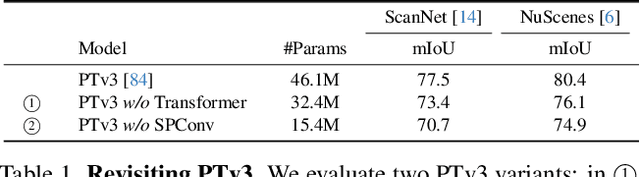
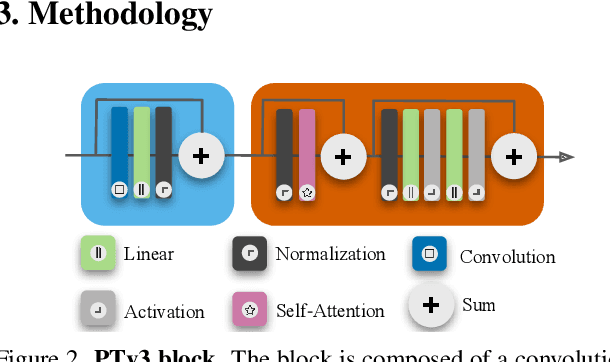

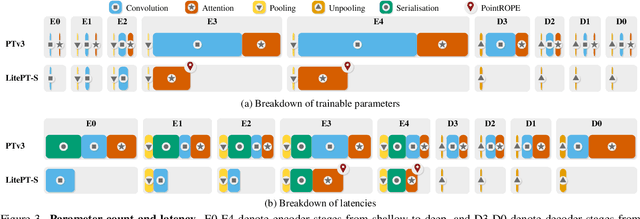
Modern neural architectures for 3D point cloud processing contain both convolutional layers and attention blocks, but the best way to assemble them remains unclear. We analyse the role of different computational blocks in 3D point cloud networks and find an intuitive behaviour: convolution is adequate to extract low-level geometry at high-resolution in early layers, where attention is expensive without bringing any benefits; attention captures high-level semantics and context in low-resolution, deep layers more efficiently. Guided by this design principle, we propose a new, improved 3D point cloud backbone that employs convolutions in early stages and switches to attention for deeper layers. To avoid the loss of spatial layout information when discarding redundant convolution layers, we introduce a novel, training-free 3D positional encoding, PointROPE. The resulting LitePT model has $3.6\times$ fewer parameters, runs $2\times$ faster, and uses $2\times$ less memory than the state-of-the-art Point Transformer V3, but nonetheless matches or even outperforms it on a range of tasks and datasets. Code and models are available at: https://github.com/prs-eth/LitePT.